


Key takeaways:
- In a randomised trial in adults with IBS, 81% receiving the studied Nerva intervention achieved at least a 50-point reduction on the IBS Symptom Severity Scale at programme completion, compared with 63% receiving an active digital control.
- The trial tested a digital programme with gut-directed hypnotherapy against a programme without hypnotherapy; it did not compare competing digestive care companies.
- Nerva is a personalised digital digestive care programme; the trial provides evidence for the studied intervention within its brain-gut behavioural care.
- Nerva's current programme combines clinical screening, behavioural care, dietary guidance, symptom tracking and escalation, with six-week core and continued maintenance access.
In a randomised trial in adults with IBS, 81% receiving the studied Nerva intervention achieved at least a 50-point reduction on the IBS Symptom Severity Scale at programme completion, compared with 63% receiving an active digital control. The trial tested digitally delivered gut-directed hypnotherapy, an approach within Nerva's brain-gut behavioural care. Here is what the study established and how it relates to the current care programme.
The results were published online on 28 June 2024 and in the February 2025 issue of the American Journal of Gastroenterology. Read the published study abstract.
What did the trial compare?
Adults with IBS were assigned to a digital study programme with gut-directed hypnotherapy, delivered through Nerva, or an active control without hypnotherapy. The abstract reports 244 randomised participants, of whom 240 received the programmes: 121 in the Nerva group and 119 in the control group.
The primary endpoint was the proportion of participants whose IBS Symptom Severity Scale score fell by at least 50 points at programme completion. This is a threshold for meaningful improvement in a symptom score, rather than a measure of whether someone was cured.
What were the results?
At programme completion, 81% in the hypnotherapy group met the primary endpoint, compared with 63% in the active-control group (P = .002).
A reduction of at least 30% in abdominal pain was reported by 71% versus 35%, respectively (P < .001). Quality of life improved more with hypnotherapy. Psychological status improved similarly in both groups.
These are different outcomes. The 81% figure is not an 81% reduction in symptoms, and the 71% figure refers to a defined pain-response threshold. Neither percentage is a guarantee about an individual person's experience.
How should the findings be interpreted?
The trial provides controlled evidence for digitally delivered gut-directed hypnotherapy within Nerva's brain-gut behavioural approach. Its active comparison matters: both groups received a digital programme, and the group receiving hypnotherapy had a higher symptom-response rate.
The findings apply to the intervention studied in adults with IBS. The population was predominantly female. The trial did not compare Nerva with Oshi, Cylinder, Ayble or a low-FODMAP diet, and it did not separately evaluate every component of today's broader care programme.
The study included follow-up after the programme. The primary result described here is the comparison at programme completion; it should not be relabeled as a six-month response rate.
Is this the same as the 2016 low-FODMAP study?
No. Peters and colleagues' 2016 trial compared therapist-delivered gut-directed hypnotherapy, a low-FODMAP diet and their combination. It did not test the Nerva app. It is evidence about those approaches, while the Anderson trial provides evidence about the digital Nerva study programme.
From clinical evidence to personalised digestive care
Nerva is a personalised digital digestive care programme combining clinical screening, brain-gut behavioural care, dietary guidance, symptom tracking and escalation when needed. It includes a six-week core programme and continued maintenance access. Gut-directed hypnotherapy is one component of its brain-gut behavioural care. Explore the full care programme and watch the demo.
Bring evidence-supported brain-gut behavioural care into your patients' digestive care. See how to refer a patient to Nerva.
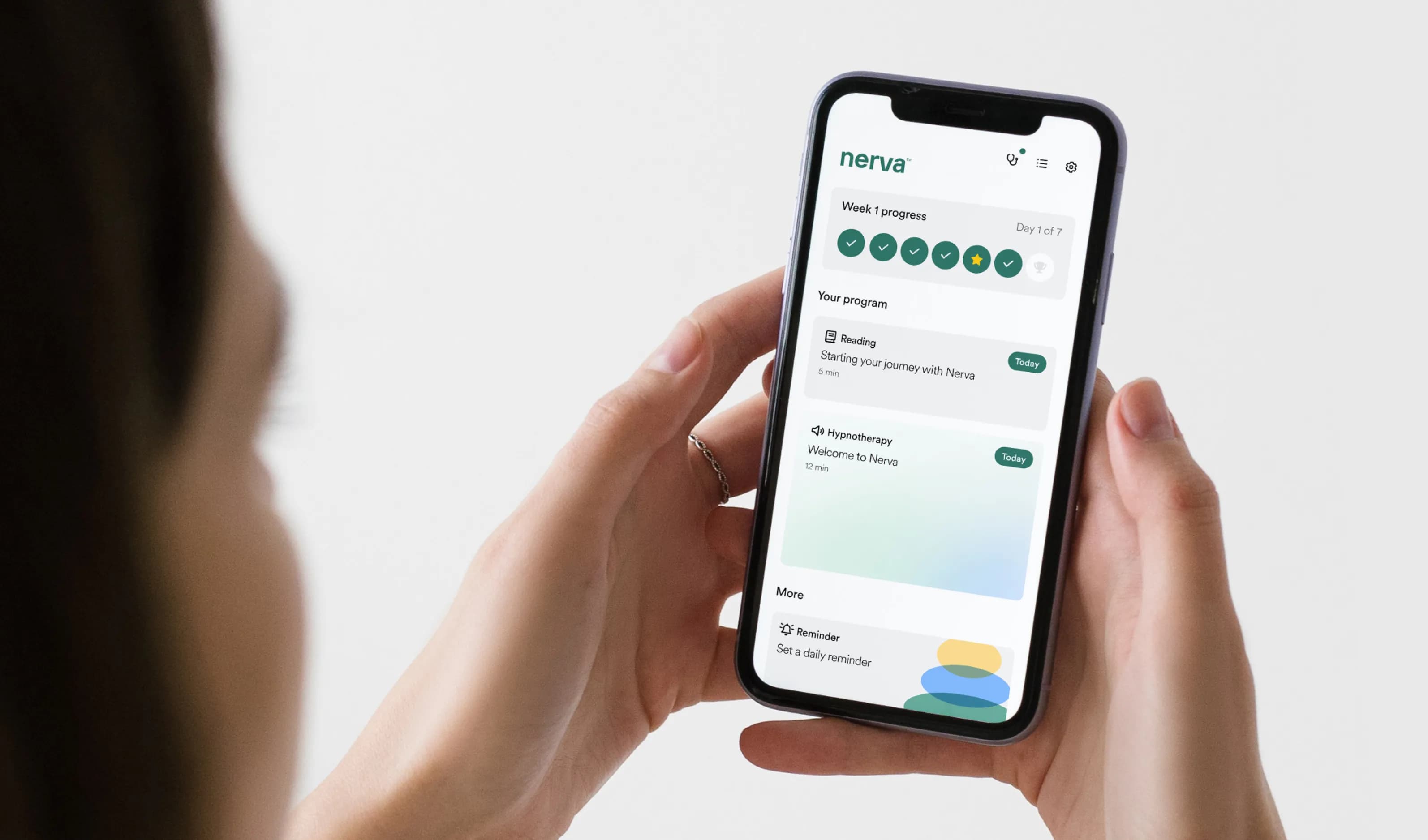
For other publications and study summaries, visit Nerva's research library.
References
Anderson EJ, Peters SL, Gibson PR, Halmos EP. Comparison of Digitally Delivered Gut-Directed Hypnotherapy Program With an Active Control for Irritable Bowel Syndrome. American Journal of Gastroenterology. 2025;120(2):440–448. Published online 28 June 2024. PubMed study abstract. doi:10.14309/ajg.0000000000002921.
Peters SL, Yao CK, Philpott H, Yelland GW, Muir JG, Gibson PR. Randomised clinical trial: the efficacy of gut-directed hypnotherapy is similar to that of the low FODMAP diet for the treatment of irritable bowel syndrome. Alimentary Pharmacology & Therapeutics. 2016;44(5):447–459. PubMed study abstract.

