.webp)
Key takeaways:
- Gut-directed hypnotherapy uses guided relaxation, focused attention and gut-focused imagery to help people manage IBS symptoms.
- You remain aware and in control during hypnosis; the process is different from stage hypnosis.
- You can access gut-directed hypnotherapy through a qualified clinician or a self-guided program, with different levels of personal support.
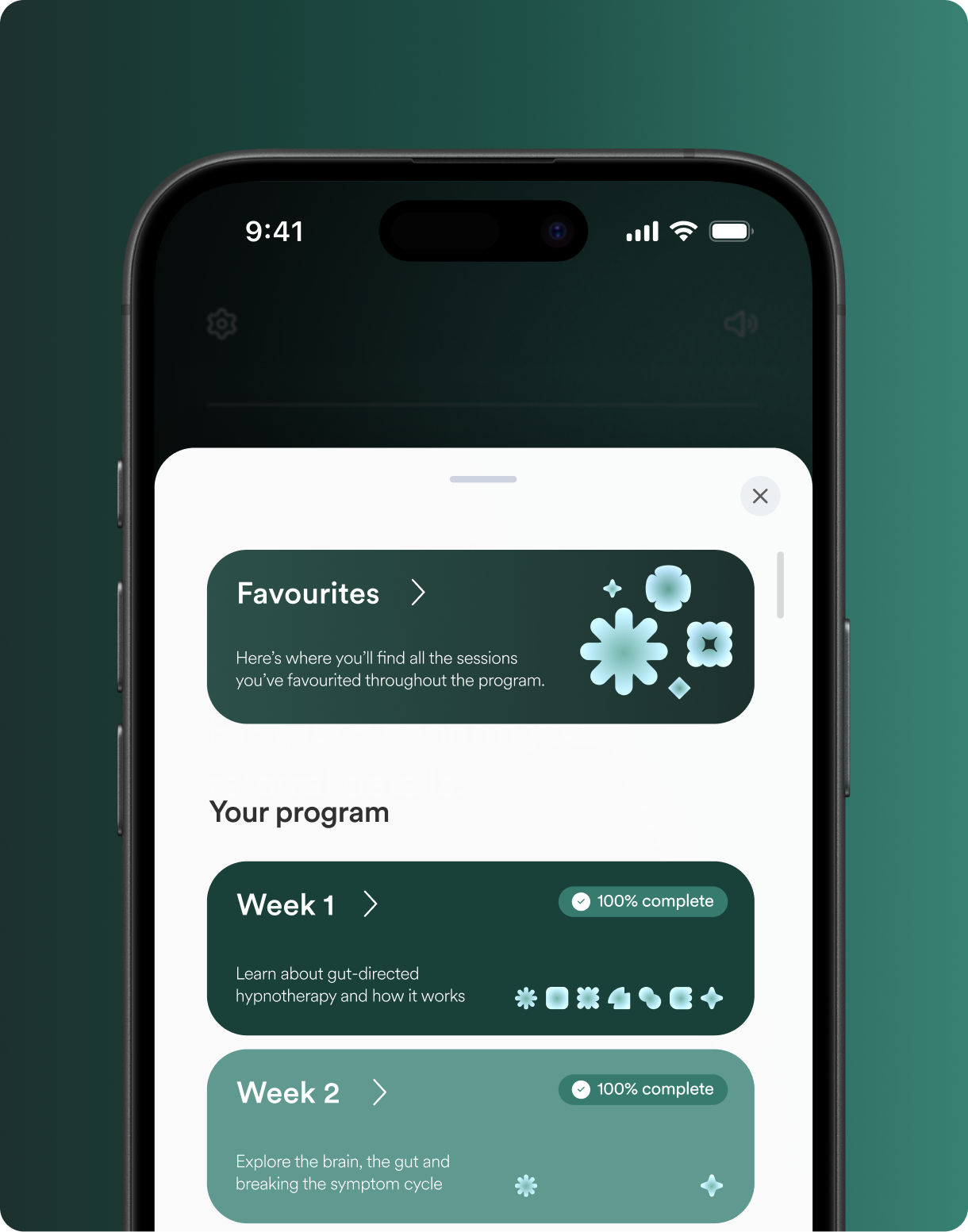
- Nerva's core program runs for six weeks, with short daily audio sessions of around 15 minutes.
Gut-directed hypnotherapy is a psychological approach to managing IBS that combines guided relaxation, focused attention and imagery directed toward your gut. Also called gut-focused hypnotherapy or IBS hypnotherapy, it works with the gut-brain connection, one of the factors involved in digestive symptoms. [1]
If you're considering it, you probably want to know what a session feels like, whether the research is convincing, and how to fit the practice into your day. This guide explains those choices, including the differences between working with a clinician and using an app at home.
Looking for an at-home option? Explore Nerva's gut-directed hypnotherapy program. You can learn about the program and watch the demo before deciding to take the quiz.
Why consider the gut-brain connection for IBS?
IBS is a disorder of gut-brain interaction. That does not mean symptoms are imagined. People with IBS can experience pain, altered bowel habits and sensitivity to normal activity in the gut. More than one factor can contribute, and the combination differs between people. [2]
Some people feel pain when ordinary amounts of gas or stool are present. You may hear this increased sensitivity called visceral hypersensitivity. Thinking about sensitivity helps explain why managing IBS is not always just a question of identifying one food to avoid. It does not establish that every person's IBS has one cause, or that an app can fix a single faulty signal. [2]
The American College of Gastroenterology includes gut-directed psychological approaches among options for IBS. This is guidance about a class of approaches; it is not an endorsement of every app that uses related techniques. [1]
What happens during a session?
A gut-directed hypnotherapy session commonly guides you through relaxation, focused imagery and suggestions related to digestive comfort. Rather than requiring you to solve a problem intellectually, the exercise asks you to follow the guidance and practice focusing your attention. [1], [3]
Settle into the session. Follow the voice as it guides your attention toward breathing and relaxation.
Use gut-focused imagery. Listen to descriptions or suggestions that focus on digestive sensations and comfort.
Return to your day. The session finishes and you continue the practice at another scheduled time.
You remain in control during hypnosis. The guided practice is different from stage hypnosis; you can listen and follow the session at your own pace.
The format depends on the service. A clinician can discuss your situation and tailor care within their professional scope. A recorded program gives you a repeatable listening routine. Before choosing either, find out what you will receive, how much practice is expected, and what support is available.
How long does gut-directed hypnotherapy take to work?
Gut-directed hypnotherapy is usually practiced as a course over several weeks. The six-week mark is a study or program endpoint, rather than a deadline by which every person will feel better. The 2016 Monash study assessed symptoms after six weeks; the Nerva trial assessed its primary outcome at program completion. [4], [5]
For Nerva, the practical commitment is around 15 minutes of guided audio a day through a six-week core program. A clinician-led course may use a different appointment and home-practice schedule. Choose a format you can realistically make time for, and ask what follow-up support is available. [6]
What does the evidence show?
There is research on therapist-delivered gut-directed hypnotherapy and on particular digital programs. Keep those bodies of evidence separate: changing the delivery, duration or program can change what a study tells you.
Nerva's randomized trial
A randomized trial in adults with IBS compared Nerva with a digital active control without hypnotherapy. At program completion, 81% in the Nerva group versus 63% in the control group met the primary outcome: a reduction of at least 50 points on the IBS Symptom Severity Scale. The results describe adults with IBS in this trial; they do not establish the same benefit for children, other conditions or every person who uses the app. The threshold measures symptom improvement, rather than cure. The study appeared online in June 2024 and in the February 2025 journal issue. [4]
Read the study explanation for the participants, comparator, outcomes and limitations.
How does it compare with low FODMAP?
In a 2016 Monash University trial, therapist-delivered gut-directed hypnotherapy produced improvements in overall gastrointestinal symptoms similar to those of a low-FODMAP diet. This trial did not test Nerva, so it cannot establish that Nerva works as well as low FODMAP. [5]
Dietary management and gut-directed hypnotherapy involve different activities. One changes aspects of food intake; the other involves guided practice. A clinician or dietitian can help you consider these options in the context of your existing care.
Therapist-led care or an app?
Choose based on the service you need, not just whether the word hypnotherapy appears on the page.
Therapist-led care: ask about the clinician's qualifications, IBS experience, session format, follow-up and fees.
An app: check what the program contains, whether its own version has been studied, what support is available, and the current subscription terms.
Either option: look for transparent evidence and realistic expectations. A general claim that hypnotherapy is effective does not establish that every provider or program will produce the same result.
Nerva is a self-guided gut-directed hypnotherapy program. Its guided audio practice is different from an appointment with a clinician. Explore the program if that format interests you; seek professional care if you need diagnosis, treatment decisions or individualized clinical support. [6]
What is a sensible next step?
If your symptoms have not been assessed, speak with a healthcare professional rather than relying on a quiz or an app to identify their cause. If you have an IBS diagnosis, you can ask whether gut-directed hypnotherapy fits your management plan. [7]
Get medical advice for new, worsening or worrying symptoms. Blood in your stool, unexplained weight loss or anemia can point to a condition other than IBS and need medical assessment. These are examples, rather than a complete list. [7]
If you already have an IBS diagnosis and prefer to practice at home, explore Nerva's self-guided gut-brain program. See what the six-week program involves and watch the demo before deciding whether to start the quiz. The program page has the current access and subscription details.
See how Nerva works and watch the demo
References
American College of Gastroenterology. Psychological and behavioral therapies for IBS. ACG treatment overview.
NIDDK. Symptoms and causes of irritable bowel syndrome. Symptoms and causes.
American College of Gastroenterology. Irritable bowel syndrome. ACG patient information.
Anderson EJ, Peters SL, Gibson PR, Halmos EP. Comparison of digitally delivered gut-directed hypnotherapy program with an active control for irritable bowel syndrome. Am J Gastroenterol. 2025;120:440–448. PubMed study abstract.
Peters SL et al. Randomised clinical trial: the efficacy of gut-directed hypnotherapy is similar to that of the low FODMAP diet for the treatment of irritable bowel syndrome. Aliment Pharmacol Ther. 2016;44:447–459. PubMed study abstract.
Nerva. Current program information.
NIDDK. Diagnosis of irritable bowel syndrome. Diagnosis.