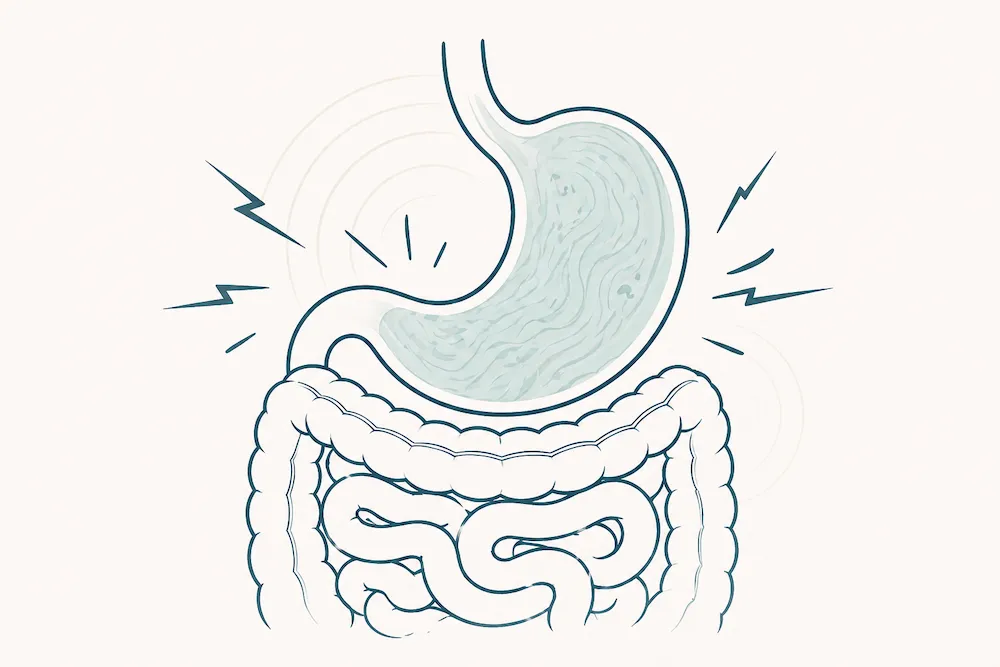
The ENS is often referred to as your ‘second brain’ due to its complexity. It consists of millions of neurons that surround your digestive tract and control digestion. The ENS connects to your central nervous system, brain, and spinal cord, it’s literally affected by processes in your brain.
When you get diarrhea because of anxiety or IBS, it’s a sign your ENS is malfunctioning. And signals controlling motility (the speed of materials transiting through your intestines) are being disrupted, bringing on that urgent need to defecate.
This is why your anxiety may be leading to physical digestive symptoms such as diarrhea.
How to stop anxiety diarrhea
If you’re experiencing sustained, ongoing diarrhea (even without anxiety), you should seek immediate medical help if you have:
If you don’t have these symptoms, treatments for diarrhea and stress-management strategies can help you feel better.
Though, it’s still a good idea to chat with your doctor about your treatment options.
Treatments for diarrhea
Rehydrating your body is often priority one for managing your anxiety-related diarrhea symptoms.
Here’s what you can try:
Rehydration: although not technically a treatment, it’s important to counteract the dehydration in diarrhea.
Oral rehydration: this will help you replace lost salts and minerals from diarrhea.
Medications: try anti-diarrheal medications, or antibiotics might help if your diarrhea was caused by an infection.
Avoid exercise: take a break from your workout as strenuous exercise may lead to further dehydration.
Fluid IV replacement: this option is for severe cases where rehydrating your body is critical.
You should consult your doctor to confirm the best treatment for your condition, particularly if you think you have an ongoing issue like inflammatory bowel disease.
Stress-management strategies for diarrhea
As well as treating your diarrhea, implementing stress-management strategies may help relieve some of your anxiety, which could be the root cause of your symptoms.
These techniques and treatments will work to prevent your body from being triggered by outside stressors.
Here are some ideas:
Cognitive Behavioral Therapy (CBT)
CBT can help you identify thoughts that generate anxiety. And you’ll learn how to change your behavior to respond differently in anxiety-provoking situations. CBT can lessen anxiety and improve your gastrointestinal symptoms.
Hypnotherapy
First you’ll undergo a hypnotic induction. Then, suggestions are made to address your thought patterns that are associated with anxiety. Hypnotherapy has been proven to be at least as effective as CBT for treating anxiety disorders and IBS. You can try hypnotherapy through a mobile app like Nerva or in-person with a hypnotherapist.
Mindfulness meditation
This practice of focusing awareness on the present moment has been shown to reduce anxiety and stress. IBS symptoms such as abdominal pain and bloating in particular could improve with mindfulness meditation.
Yoga
Practicing yoga can relieve stress and also specific symptoms of diarrhea-predominant IBS. And research has shown yoga can be more effective in relieving symptoms than anti-diarrheal medication.
Lifestyle adjustments to improve diarrhea
Over a more extended period, there’s a range of lifestyle adjustments you can make that will help prevent diarrhea symptoms.
These include:
Scientific insights into anxiety and diarrhea
Researchers have recently illuminated some fascinating links between your brain and gut. These insights are helping us better understand the connection between diarrhea and anxiety.
Anxiety increases the speed of transit of food through your gut
One study showed that generalized anxiety disorder (GAD) causes physical changes to your digestive system. In anxiety patients, the transit of food from mouth to rectum was found to be 14 hours on average. This is much faster than the 42-hour average in the control group.
Therefore, this research demonstrates that anxiety can physically alter the speed at which food passes through your intestines, which is one more explanation for the link between diarrhea and anxiety.
Online hypnotherapy reduces IBS symptoms
Researchers found that IBS symptoms improved in 65% of subjects who received hypnotherapy delivered online. This was just slightly lower than the 76% of people who improved their IBS after face-to-face treatment.
With the Nerva program, 89% of users reported better managed gut symptoms after six weeks of at-home hypnotherapy.
The Wrap Up
Your nervous system and stomach are intimately linked. It’s possible that experiencing anxiety can trigger a flare-up of diarrhea. Anxiety and diarrhea may also be a sign of IBS. If you experience diarrhea or other IBS symptoms and mental health conditions such as anxiety disorders, there are treatments available to help you manage stressful situations and improve your anxious stomach. Relaxation techniques may help improve your gastrointestinal symptoms and tame your upset stomach, with digital hypnotherapy like Nerva being especially beneficial.
References
1. Schiller, L.R., 2000. Diarrhea. Medical Clinics of North America, 84(5), pp.1259-1274. Link
2. Davis, M., 1992. The role of the amygdala in fear and anxiety. Annual review of neuroscience, 15(1),pp.353-375. Link
3. Hudlicka, O., 1985. Regulation of muscle blood flow. Clinical physiology (Oxford,England), 5(3), pp.201-229. Link
4. Chey, W.D.,Kurlander, J. and Eswaran, S., 2015. Irritable bowel syndrome: a clinical review. Jama, 313(9), pp.949-958. Link
5. Fond, G., Loundou,A., Hamdani, N., Boukouaci, W., Dargel, A., Oliveira, J., Roger, M., Tamouza,R., Leboyer, M. and Boyer, L., 2014. Anxiety and depression comorbidities in irritable bowel syndrome (IBS): a systematic review and meta-analysis. European archives of psychiatry and clinical neuroscience, 264(8), pp.651-660. Link
6. Schmulson, M.J. andDrossman, D.A., 2017. What is new in Rome IV. Journal of neurogastroenterology and motility, 23(2), p.151. Link
7. Guilera, M., Balboa,A. and Mearin, F., 2005. Bowel habit subtypes and temporal patterns in irritable bowel syndrome: systematic review. The American journal of gastroenterology, 100(5), p.1174. Link
8. Pimentel, M., 2018.Evidence-based management of irritable bowel syndrome with diarrhea. The American journal of managed care, 24(3 Suppl), pp.S35-S46. Link
9. Haug, T.T., Mykletun,A. and Dahl, A.A., 2002. Are anxiety and depression related to gastrointestinal symptoms in the general population?. Scandinavian Journal ofGastroenterology, 37(3), pp.294-298. Link
10. Walker, E.A., Katon, W.J., Jemelka, R.P. and Roy-Byrne, P.P., 1992.Comorbidity of gastrointestinal complaints, depression, and anxiety in the Epidemiologic Catchment Area (ECA) Study. The American journal of medicine, 92(1), pp.S26-S30. Link
11. Cryan, J.F. and O’mahony, S.M., 2011. The microbiome‐gut‐brain axis:from bowel to behavior. Neurogastroenterology & Motility, 23(3),pp.187-192. Link
12. Furness, J.B., 2006. The enteric nervous system. Link
13. Farthing, M.J.G., 2000. Diarrhoea: a significant worldwide problem. International journal of antimicrobial agents, 14(1),pp.65-69. Link
14. Gonsalkorale, W.M., Miller, V., Afzal, A. and Whorwell, P.J., 2003. Longterm benefits of hypnotherapy for irritable bowel syndrome. Gut, 52(11),pp.1623-1629. Link
15. Tang, Q.L., Lin, G.Y. and Zhang, M.Q., 2013. Cognitive-behavioral therapy for the management of irritable bowel syndrome. World Journal ofGastroenterology: WJG, 19(46), p.8605. Link
16. Gaylord, S.A., Palsson, O.S., Garland, E.L., Faurot, K.R., Coble, R.S.,Mann, J.D., Frey, W., Leniek, K. and Whitehead, W.E., 2011. Mindfulness training reduces the severity of irritable bowel syndrome in women: results of a randomized controlled trial. The American journal of gastroenterology, 106(9), p.1678. Link
17. Kuttner, L., Chambers, C.T., Hardial, J., Israel, D.M., Jacobson, K. andEvans, K., 2006. A randomized trial of yoga for adolescents with irritable bowel syndrome. Pain Research and Management, 11(4), pp.217-224. Link
18. Guandalini, S., 2011. Probiotics for prevention and treatment of diarrhea. Journal of Clinical Gastroenterology, 45, pp.S149-S153. Link
19. Gorard, D.A., Gomborone, J.E., Libby, G.W. and Farthing, M.J., 1996.Intestinal transit in anxiety and depression. Gut, 39(4), pp.551-555. Link
20. Hasan, S.S., Pearson, J.S., Morris, J. and Whorwell, P.J., 2019. Skype hypnotherapy for irritable bowel syndrome: effectiveness and comparison with face-to-face treatment. International Journal of Clinical and ExperimentalHypnosis, 67(1), pp.69-80. Link
Gao J. Correlation between anxiety-depression status and cytokines in diarrhea-predominant irritable bowel syndrome. Exp Ther Med. 2013;6(1):93-96. doi:10.3892/etm.2013.1101
Singh P, Agnihotri A, Pathak MK, et al. Psychiatric, somatic and other functional gastrointestinal disorders in patients with irritable bowel syndrome at a tertiary care center. J Neurogastroenterol Motil. 2012;18(3):324-331. doi:10.5056/jnm.2012.18.3.324


.jpeg)