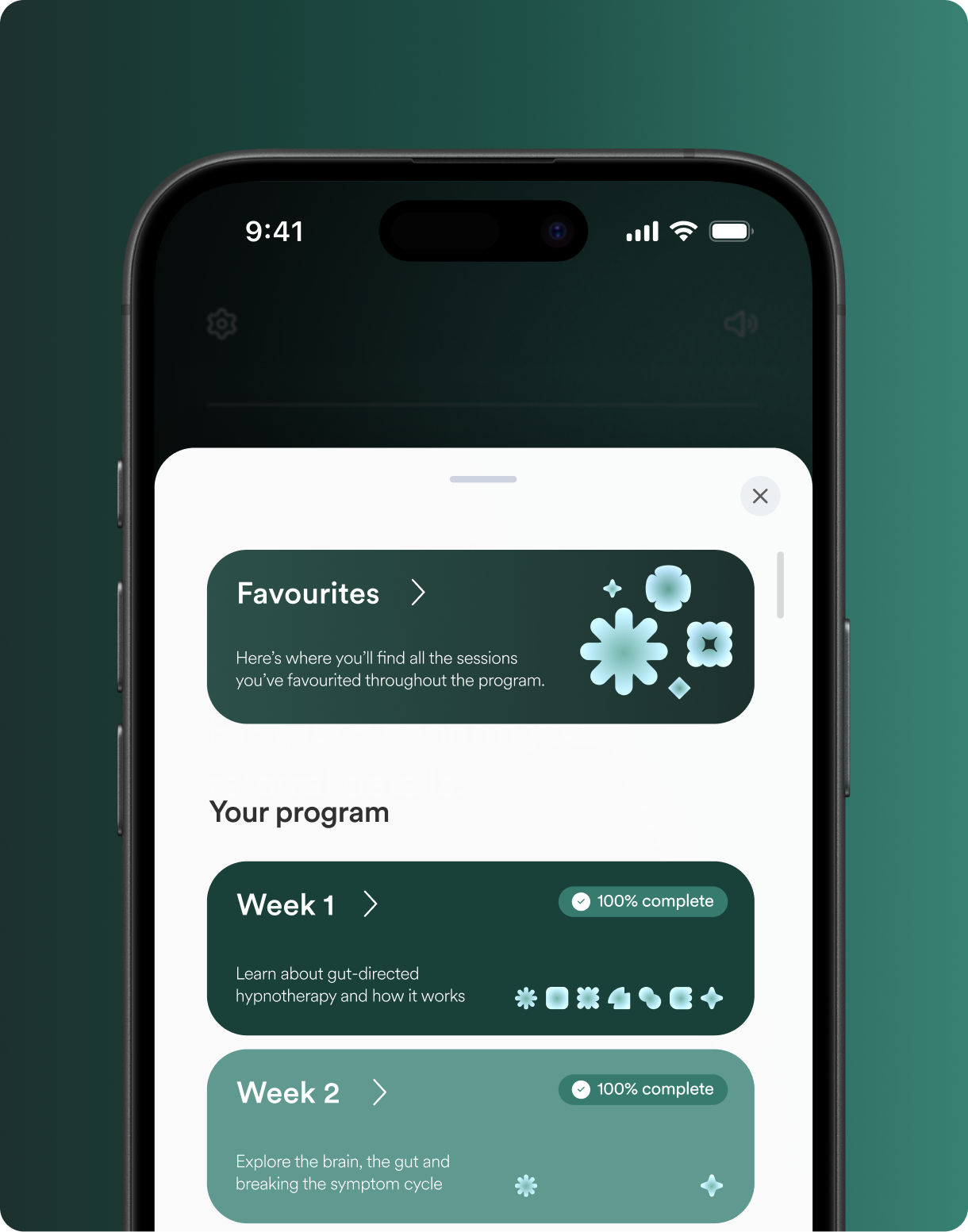
One thing we do know is that stress can have a big impact on your IBS symptoms, and hypnotherapy has been shown to be an effective form of stress relief⸺possibly acting as a circuit breaker for your symptoms.

Is hypnotherapy effective for IBS?
Hypnotherapy has been demonstrated to be effective for treating symptoms of IBS. One study from Melbourne, Australia, showed that a six-week course of hypnotherapy reduced symptoms of IBS, such as abdominal pain, bloating, and nausea, in 72% of patients.
This improvement was maintained for six months after treatment, suggesting a long-term benefit of hypnotherapy.
Research has also shown that hypnotherapy can be as effective as strict elimination diets, such as low FODMAP, for reducing IBS symptoms, and more effective than medications such as laxatives and antispasmodics.
Hypnotherapy has been endorsed by the American College of Gastroenterology for treating IBS.
What is CBT?
CBT is a form of talk therapy that focuses on replacing negative thought patterns with more positive and realistic ones. It is an evidence-based treatment option for a range of psychological conditions such as depression and anxiety, as well as helping people cope with physical conditions, such as IBS.
While hypnotherapy aims to address the altered connection between the brain and the gut in IBS, CBT focuses on coping strategies and tools to manage symptoms. CBT helps people set goals and build skills to cope with the challenges of life, including painful sensations in the gut.
CBT is administered by a qualified therapist, who may teach you a variety of cognitive and behavioural techniques, such as:
Positive self-talk
Exposure to fear-evoking situations
Removing negative thoughts
Challenging irrational thoughts
Deep breathing
During a session for IBS, you will work with the therapist on any distorted thoughts, feelings, and emotions caused by painful sensations. This may help you better cope and reduce any anxiety and stress you have related to IBS.
CBT also focuses on education. For IBS, the therapist may teach you about how stress and anxiety may impact your gastrointestinal tract. Then, they may take you through some stress management techniques to help you manage stressful experiences.
The therapist may also assign tasks for you to practice and complete at home. For example, you may be asked to record your emotions during the week which can be reflected upon in the next session.
How does CBT work for IBS?
Over time, CBT may help you to better control your mind’s response to the sensations of pain and discomfort with IBS.
CBT works by addressing psychological factors, such as anxiety, that play a role in symptoms of IBS. For example, you will learn how to avoid catastrophizing symptoms and have the tools to manage feeling overwhelmed by your IBS symptoms.
Is CBT effective for IBS?
Research has demonstrated that CBT is effective in helping to reduce the severity of IBS symptoms. One large review of over 40 clinical trials of psychological interventions for IBS showed a benefit in approximately one-third of patients receiving CBT.
This statistic is higher than results seen by people using several medications to treat their IBS.
Hypnotherapy or CBT, which is better for IBS?
Between CBT and hypnotherapy, there is no clearly superior treatment option for IBS. Both approaches have been demonstrated as effective for reducing symptoms of IBS. Both CBT and hypnotherapy are psychological approaches, meaning you will not have to restrict your diet in order to reduce IBS symptoms.
The difference between them is that CBT is designed to build healthy coping strategies and thought patterns whereas hypnotherapy helps the brain modulate pain signals from the root cause of IBS pain, oversensitive nerves in the gut.
Both CBT and hypnotherapy are designed to work with a range of patients. However, no treatment for IBS works in all cases, so it is worth consulting a healthcare professional for advice on which treatment option is better for you.
The Wrap Up
IBS can be a debilitating condition that can severely impact a person’s quality of life. Although many treatment options are available, finding an effective management tool can be challenging.
Cognitive behavioral therapy (CBT) and hypnotherapy are becoming more commonly prescribed to manage IBS symptoms. Hypnotherapy involves progressive relaxation, followed by suggestions and soothing imagery tailored to a person’s symptoms. CBT involves retraining a person’s thought patterns to cope with the symptoms of IBS. Both approaches have been shown to reduce individual and overall symptoms of IBS. If you are considering CBT or hypnotherapy, it is important to work with a well-trained, qualified therapist and consult your doctor before starting a program.
References
Hammond, D.C., 2010. Hypnosis in the treatment of anxiety-and stress-related disorders. Expert review of neurotherapeutics, 10(2), pp.263-273. https://www.tandfonline.com/doi/abs/10.1586/ern.09.140
IFFGD. 2021. Hypnosis Treatment of Irritable Bowel Syndrome - IFFGD. [online] Available at: <https://iffgd.org/resources/publication-library/hypnosis-treatment-of-irritable-bowel-syndrome/> [Accessed 17 September 2021]. https://iffgd.org/resources/publication-library/hypnosis-treatment-of-irritable-bowel-syndrome/
Ford, Alexander C. MB ChB, MD, FRCP1; Moayyedi, Paul BSc, MB ChB, PhD, MPH, FACG, FRCP, FRCPC, AGAF2; Chey, William D. MD, FACG, AGAF, FACP3; Harris, Lucinda A. MD, FACG4; Lacy, Brian E. MD, PhD, FACG5; Saito, Yuri A. MD, MPH, FACG6; Quigley, Eamonn M. M. MD, MACG, FRCP, FACP, FRCPI7 for the ACG Task Force on Management of Irritable Bowel Syndrome American College of Gastroenterology Monograph on Management of Irritable Bowel Syndrome, American Journal of Gastroenterology: June 2018 - Volume 113 - Issue - p 1-18 doi: 10.1038/s41395-018-0084-x
Ballou, S. and Keefer, L., 2017. Psychological interventions for irritable bowel syndrome and inflammatory bowel diseases. Clinical and translational gastroenterology, 8(1), p.e214. https://www.ncbi.nlm.nih.gov/pmc/articles/PMC5288603/
Breit S, Kupferberg A, Rogler G, Hasler G. Vagus Nerve as Modulator of the Brain-Gut Axis in Psychiatric and Inflammatory Disorders. Front Psychiatry. 2018;9:44. Published 2018 Mar 13. doi:10.3389/fpsyt.2018.00044

.webp)
.jpeg)

.jpeg)