That's one clinic's findings, and they don't apply to this self-test. A quiz result can't tell you whether gut-directed hypnotherapy will help your IBS. Your doctor is the right person to talk that through with.
If you're living with IBS, you've probably been told it's "just stress" or that it's all in your head. It isn't. IBS is a disorder of gut-brain interaction, and the American College of Gastroenterology's 2021 guideline suggests gut-directed psychotherapies, which include hypnotherapy, for IBS symptoms. [8] You can read how gut-directed hypnotherapy works for what sessions involve and what the research shows.
Where Nerva fits
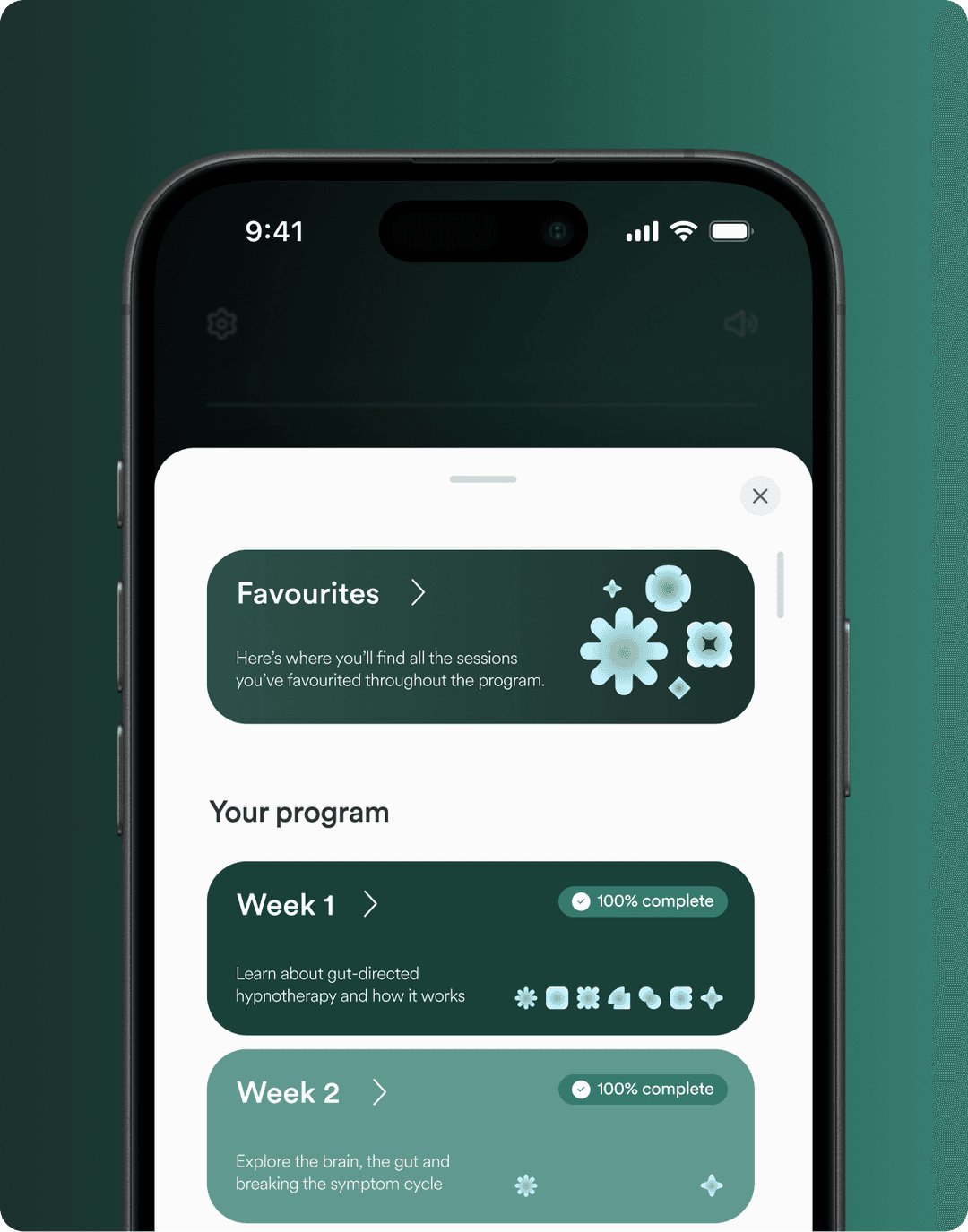
Nerva is a personalized digital digestive care program for IBS. It brings together clinical screening, brain-gut behavioral care, dietary guidance and symptom tracking, with a six-week core program and continued access afterward. Guided gut-directed hypnotherapy audio sessions of about 15 minutes are one part of it. If you have an IBS diagnosis, talk to your doctor about whether Nerva could be a useful part of your care plan.
Only a healthcare provider can diagnose IBS, so talk to your doctor about everything you use to manage your symptoms. Get medical advice for new, worsening or worrying symptoms, such as blood in your stool or unexplained weight loss. These are only examples. [9]
Frequently asked questions
Can anyone be hypnotized?
Most people respond to hypnotic suggestions to some degree. A 2021 review estimated that about 15% of people sit in the low range on formal scales. [4]
Can this test tell me if hypnotherapy will help my IBS?
No. Talk to your doctor about whether gut-directed hypnotherapy suits you.
The bottom line
The self-test is a quick, informal way to see how a short guided session feels for you. If you're considering hypnotherapy for IBS, start with a conversation with your doctor.
References
Elkins GR, Barabasz AF, Council JR, Spiegel D. Advancing research and practice: the revised APA Division 30 definition of hypnosis. Int J Clin Exp Hypn. 2015;63(1):1–9. DOI link.
Tellegen A, Atkinson G. Openness to absorbing and self-altering experiences ("absorption"), a trait related to hypnotic susceptibility. J Abnorm Psychol. 1974;83(3):268–277. DOI link.
Kekecs Z, Bowers J, Johnson A, Kendrick C, Elkins G. The Elkins Hypnotizability Scale: assessment of reliability and validity. Int J Clin Exp Hypn. 2016;64(3):285–304. DOI link.
Santarcangelo EL, Carli G. Individual traits and pain treatment: the case of hypnotizability. Front Neurosci. 2021;15:683045. DOI link.
Piccione C, Hilgard ER, Zimbardo PG. On the degree of stability of measured hypnotizability over a 25-year period. J Pers Soc Psychol. 1989;56(2):289–295. DOI link.
Morgan AH. The heritability of hypnotic susceptibility in twins. J Abnorm Psychol. 1973;82(1):55–61. DOI link.
Carruthers HR, Morris J, Tarrier N, Whorwell PJ. Mood color choice helps to predict response to hypnotherapy in patients with irritable bowel syndrome. BMC Complement Altern Med. 2010;10:75. DOI link.
Lacy BE, Pimentel M, Brenner DM, et al. ACG clinical guideline: management of irritable bowel syndrome. Am J Gastroenterol. 2021;116(1):17–44. DOI link.
NIDDK. Diagnosis of irritable bowel syndrome. Source link