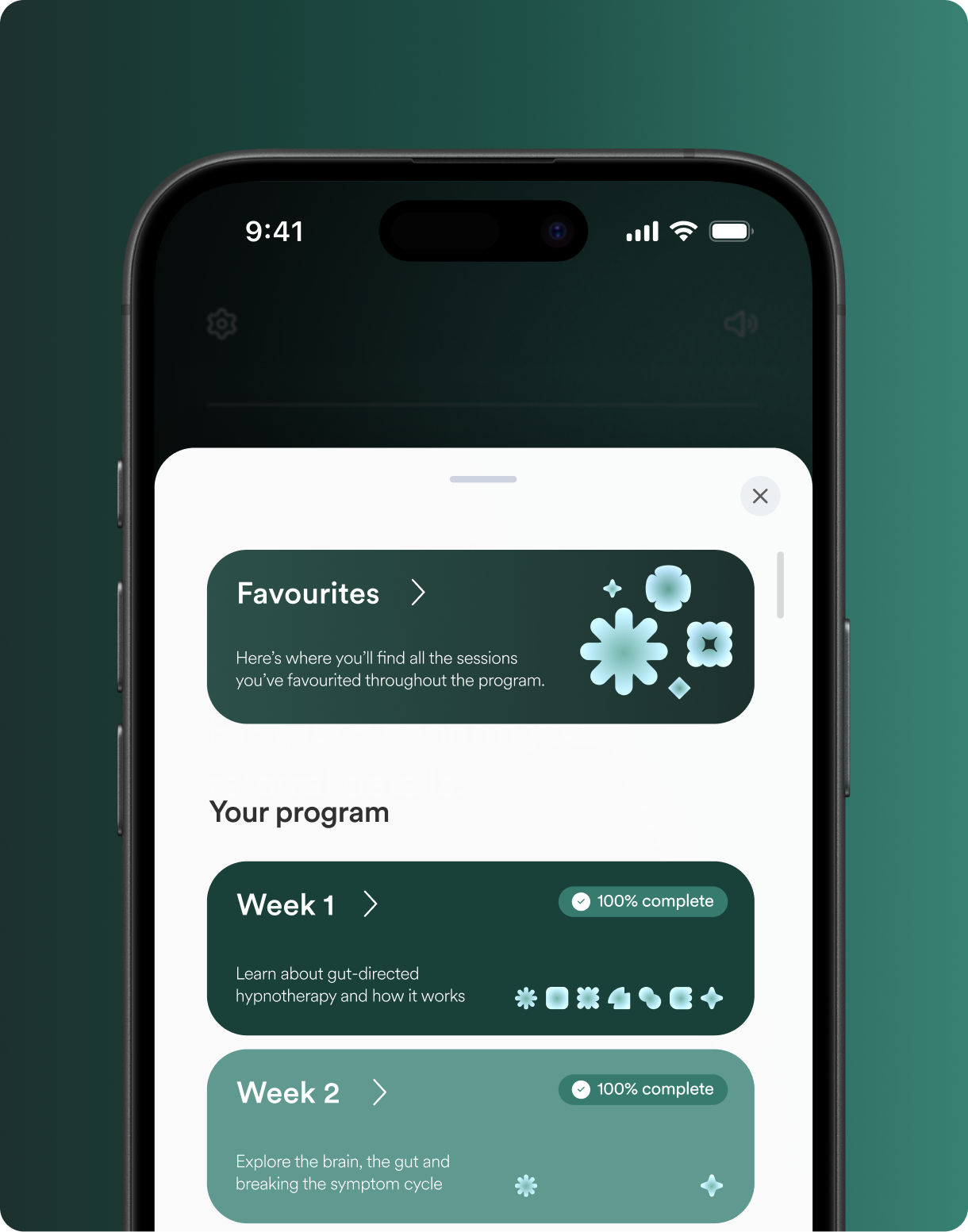
Several studies have shown that a 6-week program significantly reduces symptoms of IBS. Additionally, it has been shown to be especially useful in people with IBS who have existing mental health issues.
Hypnotherapy is thought to work by:
Lowering perceptions of pain in the brain
Reducing sensitivity to pain in the gut
Improving the speed of passage of contents through the gut
6. Get moving
Another easy and effective at-home treatment for IBS is exercise. Exercise is a natural painkiller and releases endorphins which is good for painful IBS cramps. It also helps you to manage your IBS because exercise can relieve stress and stimulate normal intestinal contractions.
In one study, exercise was found to decrease the severity of symptoms in people with IBS. Additionally, lower rates of physical activity were associated with more severe IBS symptoms.
If you have not exercised for a while, there’s no need to start running marathons. Even moderate exercise can help manage IBS symptoms. Start slow with gentle exercises such as:
7. Try Yoga
Yoga is another gentle at-home exercise that can calm your nerves and bring IBS relief. The 3000 year old practice combines breathing, meditation, and movement. Yoga has been linked with many health benefits, including the reduction of IBS gut symptoms.
While there is little scientific data around the effectiveness of specific yoga positions for gut health, yoga has certain poses designed to aid in digestion, including:
Yoga as a practice has been proven to help with IBS. Research has shown it has a beneficial effect on the autonomic nervous system that can restore the gut-brain connection.
Additionally, a recent study in adolescents with IBS showed that yoga was helpful in managing their digestive symptoms. After four weeks of 1-hour daily yoga sessions, the study participants had significantly reduced the severity of their gastrointestinal issues.
8. Peppermint oil
Another simple at-home solution for IBS includes peppermint (what could be easier than pouring a cup of tea?). Peppermint is a herb in the mint family that is an ancient herbal remedy. Peppermint is used to treat IBS and has been shown to relieve symptoms such as cramping and gas.
A review published in 2014 showed that peppermint oil significantly improves overall symptoms of IBS. Additionally, peppermint has been shown to be more effective than prescription antispasmodic medications in relieving IBS symptoms.
Peppermint oil is thought to calm symptoms of IBS by:
Reducing sensitivity to pain
Promoting the growth of ‘friendly’ bacteria in the gut
Relaxing the smooth muscles of the intestines
Having an anti-inflammatory effect
Peppermint oil is well tolerated by most people. However, very occasionally, peppermint oil may cause side-effects such as gastric reflux.
9. Probiotics
Many people with gut issues will have heard about the benefits of probiotics for digestion, especially as some popular varieties of yogurts promote probiotics as a way to balance your gut health.
Probiotics are live bacteria found in supplements and some foods. Live-bacteria might sound a bit strange, but it’s actually safe, similar to your natural gut flora (aka your naturally beneficial gut bacteria), and can provide health benefits.
These ‘friendly’ bacteria help restore balance in your gut and have been shown to improve symptoms of IBS. There is even some evidence probiotics may help with depression and anxiety.
If you want to give probiotics a try, some fermented foods that contain probiotics include:
Yogurt
Kefir
Sauerkraut
Kimchi
Tempeh
10. Prebiotics
Just like the name says, prebiotics are a kind of precursor to having healthy probiotics in your gut. Prebiotics are types of indigestible fiber. Think of them as food for your probiotics (the healthy bacteria) to eat.
Prebiotics nourish the beneficial bacteria in your gut. They have been shown to be beneficial to overall health and have been shown useful in treating IBS.
In one study, IBS-related anxiety was reduced after just 4 weeks of taking prebiotic (let’s hear a tiny round of applause for these microorganisms!).
Want to feed your healthy gut flora? Here are some common foods containing prebiotics:
Artichoke
Chicory root
Banana
Asparagus
Leeks
11. Apply heat
Another simple, soothing way to treat IBS symptoms at home is with therapeutic heat.
Direct, intense (but safe!) heat applied to the abdomen can relax the digestive tract and offer relief for those suffering from IBS. The warmth from a heat pad or hot water bottle may have a calming effect. In addition to psychological benefits, there is evidence that heat can provide pain relief.
Want to try this out at home? Place the heat pad or hot water bottle on the part of your belly that is most painful. Make sure you take extra caution not to use excessive heat as it may cause burns.
12. Use OTC treatments (with caution)
If all else fails, you can turn to over-the-counter (OTC) treatments from your local pharmacy for IBS related relief.
There are many available OTC treatments for digestion issues, such as Immodium or Pepto-Bismol. OTC medications may improve symptoms of IBS, or make them worse depending on how you use them.
When it comes to treating your IBS at-home with medications, it’s important to consult a doctor or pharmacist first and always to follow the instructions on the label.
When to see a doctor
Still not feeling relief? It might be time to consult a healthcare professional. While at-home treatments can provide effective and long-term relief, a professional opinion can help you maintain better gut health.
If you experience any of the symptoms listed below, make sure you see a healthcare professional immediately. These symptoms may suggest you have a condition other than IBS that cannot be treated at home.
The Wrap Up
IBS may cause painful symptoms but there are a range of simple things you can do at home to start feeling better and improve your gut health. Some common at-home treatments for IBS include relaxation exercises, hypnotherapy, physical activity, dietary changes, applying heat, and consuming peppermint oil or other supplements (such as prebiotics and probiotics). As always, if you notice a sudden change in your symptoms it might be time to consult a healthcare professional who may prescribe medications or provide you with advice on how to continue with at-home remedies.
References
1. Canavan, C., West, J. and Card, T., 2014. The epidemiology of irritable bowel syndrome. Clinical epidemiology, 6, p.71. https://www.ncbi.nlm.nih.gov/pmc/articles/PMC3921083/
2. Self, M.M., Czyzewski, D.I., Chumpitazi, B.P., Weidler, E.M. and Shulman, R.J., 2014. Subtypes of irritable bowel syndrome in children and adolescents. Clinical Gastroenterology and Hepatology, 12(9), pp.1468-1473. https://www.ncbi.nlm.nih.gov/pmc/articles/PMC4428553/#:~:text=and%20pain%20characteristics.-,Results,diarrhea%20(IBS%2DD).
3. Henström, M. and D’Amato, M., 2016. Genetics of irritable bowel syndrome. Molecular and cellular pediatrics, 3(1), pp.1-5. https://www.ncbi.nlm.nih.gov/pmc/articles/PMC3801318/
4. Böhn, L., Störsrud, S., Törnblom, H., Bengtsson, U. and Simrén, M., 2013. Self-reported food-related gastrointestinal symptoms in IBS are common and associated with more severe symptoms and reduced quality of life. American Journal of Gastroenterology, 108(5), pp.634-641. https://journals.lww.com/ajg/Fulltext/2013/05000/Self_Reported_Food_Related_Gastrointestinal.2.aspx?casa_token=0W3cq5 9mwagAAAAA:a5R-5-jl5ib43dDhiKUSVX4fqzGDX9OHAtn5Db7RErb9VR7SwqreXNYBphqUrqrqHLCoG8QNHA3P2gqRpWQH-Q
5. De Roest, R.H., Dobbs, B.R., Chapman, B.A., Batman, B., O'brien, L.A., Leeper, J.A., Hebblethwaite, C.R. and Gearry, R.B., 2013. The low FODMAP diet improves gastrointestinal symptoms in patients with irritable bowel syndrome: a prospective study. International journal of clinical practice, 67(9), pp.895-903. https://link.springer.com/content/pdf/10.1007/s00394-015-0922-1.pdf
6. Paulo, A.Z., Amancio, O.M.S., De Morais, M.B. and Tabacow, K.M.M.D., 2006. Low-dietary fiber intake as a risk factor for recurrent abdominal pain in children. European journal of clinical nutrition, 60(7), pp.823-827. https://www.nature.com/articles/1602386
7. Roma, E., Adamidis, D., Nikolara, R., Constantopoulos, A. and Messaritakis, J., 1999. Diet and chronic constipation in children: the role of fiber. Journal of pediatric gastroenterology and nutrition, 28(2), pp.169-174. https://journals.lww.com/jpgn/Fulltext/1999/02000/Diet_and_Chronic_Constipation_in_Children__The.15?casa_token=2yJjvXSGQ9sAAAAA:TPXLm_ys66LfrtoEjzuHAGQ2L5BjmLJpd97S4vnvBxnt__BKEIPnZdlfrjvSv2mccGBIM81gUm_clLS8grX8Jg
8. Blanchard, E.B., Lackner, J.M., Jaccard, J., Rowell, D., Carosella, A.M., Powell, C., Sanders, K., Krasner, S. and Kuhn, E., 2008. The role of stress in symptom exacerbation among IBS patients. Journal of Psychosomatic research, 64(2), pp.119-128.https://www.sciencedirect.com/science/article/pii/S0022399907003923?casa_token=S9gmSt57nk4AAAAA:KbU-hxprZoOfRtSHuqu_jcGwfmhnbJkD4qzdU9Sk3eu0Ta7Fy-OasXhhyK3CfC_uGaLUsPHR
9. Peper, E., Mason, L. and Huey, C., 2017. Healing irritable bowel syndrome with diaphragmatic breathing. Biofeedback, 45(4), pp.83-87. https://web.a.ebscohost.com/abstract?direct=true&profile=ehost&scope=site&authtype=crawler&jrnl=10815937&AN=133923226&h=PvDcNpbPSY6c2pjhTNqnJCjOom9XJgSzRIkDR%2boSuhImab7fPjCkCq28zJ2MNmgiFvLP%2bwcM1QPtDH6spgbDRQ%3d%3d&crl=c&resultNs=AdminWebAuth&resultLocal=ErrCrlNotAuth&crlhashurl=login.aspx%3fdirect%3dtrue%26profile%3dehost%26scope%3dsite%26authtype%3dcrawler%26jrnl%3d10815937%26AN%3d133923226
10. Constantinou, E., Bogaerts, K., Van Oudenhove, L., Tack, J., Van Diest, I. and Van den Bergh, O., 2015. Healing words: using affect labeling to reduce the effects of unpleasant cues on symptom reporting in IBS patients. International journal of behavioral medicine, 22(4), pp.512-520. https://link.springer.com/article/10.1007/s12529-014-9449-8
11. Blanchard, E.B., Greene, B., Scharff, L. and Schwarz-McMorris, S.P., 1993. Relaxation training as a treatment for irritable bowel syndrome. Biofeedback and Self-regulation, 18(3), pp.125-132. https://link.springer.com/content/pdf/10.1007/BF00999789.pdf
12. Lindfors, P., Unge, P., Arvidsson, P., Nyhlin, H., Björnsson, E., Abrahamsson, H. and Simrén, M., 2012. Effects of gut-directed hypnotherapy on IBS in different clinical settings—results from two randomized, controlled trials. American Journal of Gastroenterology, 107(2), pp.276-285. https://journals.lww.com/ajg/Fulltext/2012/02000/Effects_of_Gut_Directed_Hypnotherapy_on_IBS_in.22.aspx?casa_token=I73nFHIatuEAAAAA:3vSuNTfMAJVKj8I7VSJBeF3uuz5rxNGF5mU4jNqxuWErCeEv-JksRpHMELFwCeMxQEFhxMCPUn3fy2rC2PoCUQ
13. Peters, S.L., Yao, C.K., Philpott, H., Yelland, G.W., Muir, J.G. and Gibson, P.R., 2016. Randomised clinical trial: the efficacy of gut‐directed hypnotherapy is similar to that of the low FODMAP diet for the treatment of irritable bowel syndrome. Alimentary pharmacology & therapeutics, 44(5), pp.447-459. https://onlinelibrary.wiley.com/doi/abs/10.1111/apt.13706
14. Staudacher, H.M. and Whelan, K., 2017. The low FODMAP diet: recent advances in understanding its mechanisms and efficacy in IBS. Gut, 66(8), pp.1517-1527. https://gut.bmj.com/content/66/8/1517.abstract?casa_token=AapPoeUmulAAAAAA:uOSqgbTrhzTdQqDnIgrjMV5uKY9zGR-Xt4MWnpzT9uBB1hZ6o5FRhULu8pJwo216NTCxRA37Pg
15. Childs, E. and de Wit, H., 2014. Regular exercise is associated with emotional resilience to acute stress in healthy adults. Frontiers in physiology, 5, p.161. https://www.frontiersin.org/articles/10.3389/fphys.2014.00161/full
16. Daley, A.J., Grimmett, C., Roberts, L., Wilson, S., Fatek, M., Roalfe, A. and Singh, S., 2008. The effects of exercise upon symptoms and quality of life in patients diagnosed with irritable bowel syndrome: a randomised controlled trial. International journal of sports medicine, 29(9), p.778. https://www.researchgate.net/profile/Chloe_Grimmett/publication/51393313_The_Effects_of_Exercise_upon_Symptoms_and_Quality_of_Life_in_Patients_Diagnosed_with_Irritable_Bowel_Syndrome_A_Randomised_Controlled_Trial/links/5447626b0cf22b3c14e0cb0d/The-Effects-of-Exercise-upon-Symptoms-and-Quality-of-Life-in-Patients-Diagnosed-with-Irritable-Bowel-Syndrome-A-Randomised-Controlled-Trial.pdf
17. Kavuri, V., Raghuram, N., Malamud, A. and Selvan, S.R., 2015. Irritable bowel syndrome: yoga as remedial therapy. Evidence-Based Complementary and Alternative Medicine, 2015. https://www.hindawi.com/journals/ecam/2015/398156/
18. Kuttner, L., Chambers, C.T., Hardial, J., Israel, D.M., Jacobson, K. and Evans, K., 2006. A randomized trial of yoga for adolescents with irritable bowel syndrome. Pain Research and Management, 11. https://www.hindawi.com/journals/prm/2006/731628/
19. Balakrishnan, A., 2015. Therapeutic uses of peppermint-a review. Journal of pharmaceutical sciences and research, 7(7), p.474. http://search.proquest.com/openview/0fcb7e61eaa5900ea403b14471dd0145/1?pq-origsite=gscholar&cbl=54977
20. Khanna, R., MacDonald, J.K. and Levesque, B.G., 2014. Peppermint oil for the treatment of irritable bowel syndrome: a systematic review and meta-analysis. Journal of clinical gastroenterology, 48(6), pp.505-512. https://journals.lww.com/jcge/FullText/2014/07000/Peppermint_Oil_for_the_Treatment_of_Irritable.11.aspx?casa_token=NU12pmgJHa0AAAAA:TOzZm1USlqeHSGRWH2Uj6XOlcGRiX4sb2_NtxybHysV5qTPIgPh1YOPV7n03nwVeGu-cPOA_wCB2tLXObqyVHA
21. Chumpitazi, B.P., Kearns, G.L. and Shulman, R.J., 2018. the physiological effects and safety of peppermint oil and its efficacy in irritable bowel syndrome and other functional disorders. Alimentary pharmacology & therapeutics, 47(6), pp.738-752. https://onlinelibrary.wiley.com/doi/full/10.1111/apt.14519
22. McFarland, L.V. and Dublin, S., 2008. Meta-analysis of probiotics for the treatment of irritable bowel syndrome. World journal of gastroenterology: WJG, 14(17), p.2650. https://www.ncbi.nlm.nih.gov/pmc/articles/PMC2709042/
23. Ng, Q.X., Peters, C., Ho, C.Y.X., Lim, D.Y. and Yeo, W.S., 2018. A meta-analysis of the use of probiotics to alleviate depressive symptoms. Journal of affective disorders, 228, pp.13-19. https://www.sciencedirect.com/science/article/pii/S016503271731488X?casa_token=BjHaqlPPRaEAAAAA:_AUT0rh9dKkEoIB-KO2qiA9u3LYBZjPWARudRm6UlAzjkVqQFLye87_EL9f1GveB8Bt6HrLq
24. Wilson, B., Rossi, M., Dimidi, E. and Whelan, K., 2019. Prebiotics in irritable bowel syndrome and other functional bowel disorders in adults: a systematic review and meta-analysis of randomized controlled trials. The American Journal of Clinical Nutrition, 109(4), pp.1098-1111. https://academic.oup.com/ajcn/article-abstract/109/4/1098/5428039
25. Sen, S., Mullan, M.M., Parker, T.J., Woolner, J.T., Tarry, S.A. and Hunter, J.O., 2002. Effect of Lactobacillus plantarum 299v on colonic fermentation and symptoms of irritable bowel syndrome. Digestive diseases and sciences, 47(11), pp.2615-2620. https://link.springer.com/article/10.1023%2FA%3A1020597001460
26. Nadler, S.F., Steiner, D.J., Erasala, G.N., Hengehold, D.A., Hinkle, R.T., Goodale, M.B., Abeln, S.B. and Weingand, K.W., 2002. Continuous low-level heat wrap therapy provides more efficacy than Ibuprofen and acetaminophen for acute low back pain. Spine, 27(10), pp.1012-1017. https://journals.lww.com/spinejournal/Fulltext/2002/05150/Continuous_Low_Level_Heat_Wrap_Therapy_Provides.3.aspx?casa_token=OezHaz_4jeEAAAAA:WJaN5BNk7dpUM6pleDrSc2MSLOMYIX033S0aLM3dUjjKx4BpUI2BwiEi6LjnMHdmT0_Rq2ddLsYIPqFDYK8Q5Q
27. Ford, A.C., Talley, N.J., Spiegel, B.M., Foxx-Orenstein, A.E., Schiller, L., Quigley, E.M. and Moayyedi, P., 2008. Effect of fibre, antispasmodics, and peppermint oil in the treatment of irritable bowel syndrome: systematic review and meta-analysis. Bmj, 337, p.a2313. https://www.bmj.com/content/337/bmj.a2313.full
28. Boorom, K.F., Smith, H., Nimri, L., Viscogliosi, E., Spanakos, G., Parkar, U., Li, L.H., Zhou, X.N., Ok, Ü.Z., Leelayoova, S. and Jones, M.S., 2008. Oh my aching gut: irritable bowel syndrome, Blastocystis, and asymptomatic infection. Parasites & Vectors, 1(1), pp.1-16. https://parasitesandvectors.biomedcentral.com/articles/10.1186/1756-3305-1-40